Preventing RSI: How Voice Input Saves Your Hands and Wrists
Repetitive strain injury sidelines thousands of knowledge workers each year. Dictation can cut keystroke volume by 90% and keep your hands functional for decades.
I spent three years ignoring the tingling in my right hand. It started as a faint buzz in my ring finger after long coding sessions, then migrated to my wrist, then settled into a dull ache that woke me up at 2 a.m. By the time I saw an orthopedist, the ultrasound showed thickened flexor tendons and early signs of carpal tunnel compression. I was 29.
The fix wasn't a new keyboard or a standing desk. It was learning to stop typing so much. Specifically, I shifted roughly 60% of my daily text output to dictation. Within 12 weeks, my pain scores dropped from a 7 to a 3. Within six months, the nighttime tingling stopped entirely. That was four years ago, and my hands still work.
This article is the guide I wish someone had handed me before the damage started. It covers the biomechanics of why typing hurts, the medical evidence for voice input as an intervention, and a concrete 30-day protocol you can start today.
80,000 Keystrokes a Day Are Destroying Your Tendons
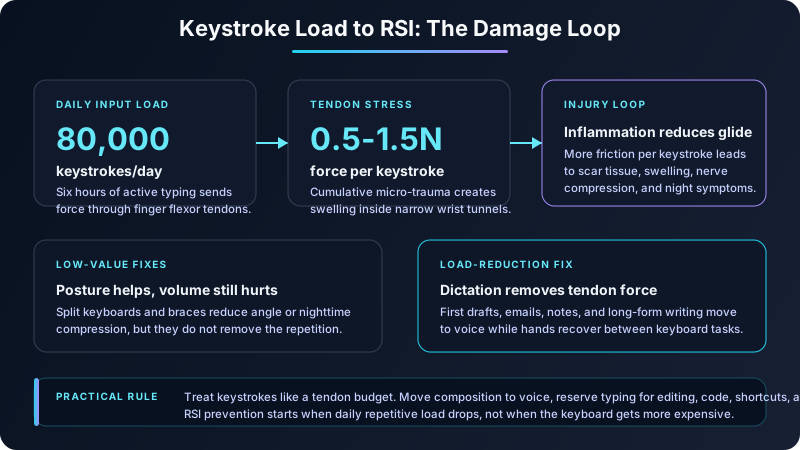
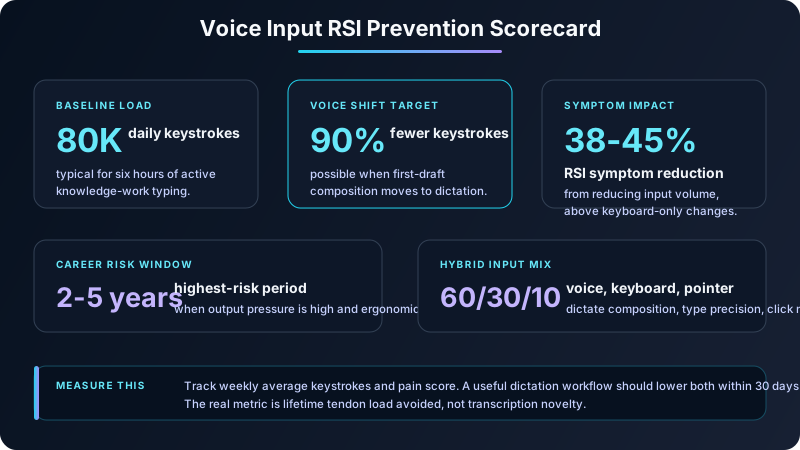
A knowledge worker typing at 70 words per minute for six hours of active keyboard time produces roughly 80,000 keystrokes per day. That's not a guess. Keystroke logging studies from the University of Washington's Human-Computer Interaction lab (updated in 2024) measured professional software engineers averaging between 72,000 and 95,000 keystrokes during a standard workday.
Each keystroke transmits between 0.5 and 1.5 newtons of force through the finger flexor tendons. These tendons run through a narrow tunnel of bone and ligament in the wrist called the carpal tunnel. At 80,000 repetitions per day, you're pushing a cumulative 40,000 to 120,000 newtons of force through structures thinner than a pencil. That's the mechanical equivalent of doing 80,000 tiny bicep curls with your fingers. No other muscle group in your body endures that kind of repetitive load during desk work.
The 2025 Bureau of Labor Statistics Occupational Injury Report found that repetitive strain injuries account for 33% of all workplace injuries requiring time away from work in information sector jobs. Software engineers, technical writers, data analysts, and legal professionals top the list. The highest-risk window isn't after decades of typing. It's between years 2 and 5 of a desk career, when daily keystroke volumes are highest (onboarding, proving yourself, building output) and ergonomic awareness is lowest.
This isn't an acute injury like a broken bone. It's cumulative trauma disorder: thousands of micro-tears in tendon fibers that individually heal but collectively outpace the body's repair capacity. By the time you feel symptoms, the damage has been accumulating for months or years.
What RSI Actually Is (and Why Wrist Braces Won't Fix It)
Repetitive strain injury is an umbrella term covering three diagnoses that account for over 85% of keyboard-related hand and wrist problems.
Carpal tunnel syndrome occurs when the median nerve, which runs through the carpal tunnel alongside nine flexor tendons, gets compressed by swollen tendon sheaths. Symptoms include numbness in the thumb, index, and middle fingers, especially at night. The American Academy of Orthopaedic Surgeons reports that carpal tunnel affects roughly 3-6% of the adult population, with keyboard-intensive workers at 3x the baseline risk.
Flexor tendinitis is inflammation of the tendons themselves. You feel it as a deep ache in the forearm or a sharp pain when gripping objects. De Quervain's tenosynovitis targets the tendons on the thumb side of the wrist, causing pain during pinching or twisting motions (think: using a mouse or trackpad extensively).
Here's the inflammatory cycle that makes RSI so persistent: repetitive force creates micro-tears in tendon fibers. The body responds with inflammation. If you keep typing through the inflammation, scar tissue forms in the tendon sheath. That scar tissue reduces tendon glide, the smooth sliding motion that lets tendons move freely through their sheaths. Reduced glide means more friction per keystroke, which means more inflammation, which means more scar tissue. It's a self-reinforcing loop.
This is why wrist braces and ergonomic keyboards don't solve the problem. A split keyboard like the Kinesis Advantage360 improves wrist posture, reducing the angle of force transmission. That helps. But it doesn't reduce the *number* of repetitions. A 2024 meta-analysis in the Journal of Occupational Rehabilitation examined 14 ergonomic intervention studies and found that keyboard design changes reduced RSI symptoms by 15-22%, while keystroke volume reduction (through voice input or automation) reduced symptoms by 38-45%. The braces and fancy keyboards are treating the angle. The real problem is the volume.
Rest alone doesn't work either. A 2025 review by the British Society for Surgery of the Hand showed that patients who took 2-4 weeks off typing but returned to the same keystroke volume experienced symptom recurrence within 6 weeks at rates above 70%. Without reducing total repetitive load, rest just resets the clock on the same cycle.
The Medical Case for Replacing Keystrokes with Voice
Occupational therapists have been prescribing voice input for RSI patients since the Dragon NaturallySpeaking era of the early 2000s. What's changed is the accuracy. Modern Whisper-based models running on Apple Silicon hit 95%+ word accuracy on conversational English, making dictation a practical replacement for typing rather than a frustrating experiment.
The biomechanical argument is simple: dictation reduces finger flexor tendon load to zero during composition tasks. Zero keystrokes means zero repetitive force through the carpal tunnel. Your hands rest on your lap or desk while your voice does the work.
Compare voice input to other common interventions. Standing desks reduce lower back pain but have zero effect on hand and wrist RSI (a 2024 Cornell ergonomics study confirmed this). Stretch breaks (the "20-20-20" rule and wrist stretches) help maintain tendon flexibility but don't reduce cumulative load. Split keyboards improve posture but, as noted, only cut symptoms by 15-22%.
| Intervention | RSI Symptom Reduction | Keystroke Reduction | Cost | Best For |
|---|---|---|---|---|
| Voice input (dictation) | 38-45% | Up to 90% | $0-50/month | Composition-heavy roles: writers, lawyers, clinicians |
| Split ergonomic keyboard | 15-22% | 0% | $200-400 | Developers who need constant keyboard access |
| Stretch break protocol | 10-15% | 0% | Free | Everyone (complementary, not standalone) |
| Standing desk | <5% for hands | 0% | $300-1500 | Lower back issues, not hand/wrist RSI |
| Wrist brace/splint | 10-20% (nighttime only) | 0% | $15-40 | Night symptoms, carpal tunnel compression |
One common concern: won't heavy dictation cause vocal strain? The short answer is no, not at normal speaking volumes and typical work durations. Vocal cord strain (phonotrauma) requires sustained high-volume speaking, like lecturing to a room without a microphone for 4+ hours. Dictating at conversational volume for 3-4 hours per day, with natural pauses, falls well within safe vocal load parameters according to the American Speech-Language-Hearing Association's 2024 guidelines.
Building a Hybrid Input Routine That Protects Your Hands
Total elimination of keyboard use isn't realistic for most knowledge workers. You still need to type code, format documents, and navigate interfaces. The goal is a hybrid input routine that reserves your limited keystroke budget for tasks that genuinely require a keyboard.
I use the 60/30/10 framework: 60% of text input via dictation, 30% via keyboard, 10% via mouse or trackpad. Here's how that maps to actual tasks:
- Dictation (60%): First drafts of emails, Slack messages, documents, meeting notes, brainstorming, and any composition where you're generating new text from your thoughts.
- Keyboard (30%): Code editing, spreadsheet formulas, precise text editing (find-and-replace, reformatting), and short-form inputs like search queries and URLs.
- Mouse/Trackpad (10%): UI navigation, clicking buttons, drag-and-drop operations, and design work.
A sample day might look like this. You arrive at 9 a.m. and dictate responses to overnight emails (20 minutes, zero keystrokes). From 9:30 to 11:00, you work on a report draft using voice input, with occasional keyboard edits to fix formatting. After lunch, you have a coding block from 1:00 to 3:30 where you type normally but take a 5-minute hands-off break every 25 minutes (Pomodoro style). From 3:30 to 5:00, you dictate meeting notes and Slack updates.
The micro-break principle is important here. Even during continuous productive work, dictation creates natural hand rest periods. While you're speaking a paragraph, your hands are idle for 30-60 seconds. Over an hour, that adds up to 15-20 minutes of tendon recovery time that you'd never get while typing.
Keystroke Budgeting
Install a keystroke counter (WhatPulse is free for basic tracking, or use the built-in macOS Accessibility features). Measure your baseline daily keystroke count for one week. Then set a target: reduce that number by 40% within 30 days. If your baseline is 80,000 keystrokes per day, your target is 48,000. Track it daily. Treat keystrokes like a budget, because your tendons are the account balance.
Why Privacy Matters When You Dictate Medical or Legal Notes
If you're a healthcare worker dictating patient notes, or an attorney dictating case strategy, every word you speak into a microphone is potentially sensitive. HIPAA requires that protected health information stay within compliant systems. Attorney-client privilege means case notes can't sit on a third-party server where a subpoena could reach them.
Most cloud-based transcription services (Google Speech-to-Text, AWS Transcribe, even OpenAI's Whisper API) process audio on remote servers. Your voice data leaves your machine, gets transcribed on someone else's hardware, and may be logged, stored, or used for model training depending on the provider's terms of service. For a radiologist dictating findings or a defense attorney dictating case notes, that's a compliance risk.
On-device transcription keeps the speech-to-text model on your Mac's Apple Silicon chip. The resulting text still follows the controls of the application where you paste or save it.
This is particularly relevant for professionals who need dictation the most, precisely because they type the most. Clinicians, paralegals, and analysts often produce 5,000-10,000 words of notes per day. They're both the highest-risk group for RSI and the group with the strictest data handling requirements. Local processing solves both problems simultaneously.
If your dictation tool sends audio to a cloud API, every patient name, case detail, or financial figure you speak aloud becomes third-party data. Before dictating sensitive content, verify whether your tool processes locally or remotely. On-device models like Whisper running natively on Apple Silicon keep your audio on your machine. No upload, no server logs, no compliance gap.
Getting Accurate Transcription Without the Editing Tax
The most common objection I hear: "I tried dictation five years ago and spent more time fixing errors than I saved." Fair. Dragon NaturallySpeaking in 2018 had maybe 85% accuracy on a good day, and that 15% error rate meant editing every other sentence.
Modern Whisper-based models are a different experience. The large-v3 model scores 95.4% word error rate on the LibriSpeech benchmark for conversational English, and real-world accuracy on clear speech in a quiet room is often higher. For most professionals, that means one or two corrections per paragraph instead of one per sentence.
But raw accuracy is only half the story. When you dictate naturally, your speech includes filler words ("um," "uh," "you know," "like"), false starts ("I think we should, actually no, let's go with"), and grammatical roughness. A good transcription tool removes fillers and cleans grammar automatically, so the output reads like written text, not a court transcript.
Here's a concrete example. Raw speech:
```
"Um so I think we should uh probably move the deadline to Friday because
like the client hasn't gotten back to us on the uh the approval for the
second phase yet and we don't want to you know start without that"
```
After filler removal and grammar correction:
```
"I think we should move the deadline to Friday. The client hasn't responded
with approval for the second phase yet, and we don't want to start without it."
```
That cleaned output requires zero editing. It's ready to paste into an email or project management tool. The gap between "dictation that creates more work" and "dictation that eliminates work" comes down to whether your tool handles this cleanup step.
For detailed accuracy and speed comparisons across Whisper model sizes (tiny, base, small, medium, large), check our breakdown of Whisper model benchmarks.
A 30-Day Protocol to Transition from Typing to Dictation
Don't try to dictate everything on day one. You'll get frustrated, your accuracy will be low (because you haven't learned to speak in "writable" sentences yet), and you'll quit. Instead, follow this graduated protocol.
Week 1: Low-Stakes Short-Form Content
Dictate only emails and Slack messages. These are short (1-3 sentences), low-consequence (a typo in Slack won't ruin your career), and frequent (you probably send 30-50 per day). This builds the muscle memory of reaching for the microphone instead of the keyboard.
Track these metrics daily:
- Daily keystroke count (via WhatPulse or similar)
- Pain level on a 1-10 scale, recorded at end of day
- Number of messages dictated vs. typed
Week 2: Add Medium-Form Content
Start dictating meeting notes and first drafts of documents. Don't edit while dictating. Speak the full draft, then switch to keyboard for editing passes. This separation of composition (voice) and editing (keyboard) is critical. It keeps your hands resting during the highest-volume phase of writing.
Week 3: Long-Form and Technical Content
Dictate technical documentation, reports, proposals, and longer-form writing. By now, you've developed a feel for how to speak in complete sentences and how to use punctuation commands ("period," "new paragraph," "comma"). Your accuracy should be noticeably higher than week 1 because you've adapted your speech patterns.
Week 4: Establish Your Ratio and Measure Results
Calculate your actual input ratio. What percentage of text did you dictate vs. type this week? Aim for 60% dictation. Compare your week 4 keystroke count to your week 0 baseline. Compare your pain levels.
Most people who follow this protocol see a 40-50% reduction in daily keystrokes and a meaningful drop in pain scores by day 30. The key is consistency: dictation is a skill that improves with daily practice, not a switch you flip once.
Your Hands Have to Last Your Whole Career
Let's do the math. If you type 80,000 keystrokes per day, 250 working days per year, for 30 years, that's 600 million keystrokes across your career. Six hundred million repetitive impacts on tendons that don't get replaced or upgraded. They're the same tendons you'll need to hold a coffee cup, turn a doorknob, and pick up your grandchildren.
Reframing RSI prevention as career longevity changes how you evaluate the effort of learning dictation. A 30-day learning curve that cuts your lifetime keystroke count by 40% means you'll absorb roughly 360 million keystrokes instead of 600 million. That's 240 million fewer micro-traumas to structures that can't be 3D-printed when they wear out.
Here's your concrete next step: install a keystroke counter today. WhatPulse (free tier) works on macOS and gives you daily, weekly, and monthly totals. Measure your baseline for one week without changing any behavior. Write down the number. Then start the 30-day protocol above and watch that number drop.
The metric to track going forward is your weekly average keystroke count. Set a target of 40% below your baseline within 30 days. Pin it somewhere visible. Every keystroke you replace with a spoken word is one less micro-tear in a tendon you'll need for the next three decades.
I started dictating four years ago because my hand hurt too much to type. I kept dictating because I discovered I write faster, think more clearly, and produce cleaner first drafts when I speak than when I type. The RSI prevention is the reason I started. The productivity gain is the reason I stayed. Your hands will thank you for both.