Dictation for Developers: Writing Code Docs With Your Voice
Software engineers spend 30% of their time writing docs, not code. Voice input can cut that in half while producing clearer comments, commit messages, and READMEs.
You just mass-renamed a variable across 14 files, wired up the new authentication middleware, and verified the tests pass. Now comes the part you dread: explaining what you did and why. You stare at the commit message field, type "refactored auth," and hit enter. The PR description? You paste in the ticket number and write "see Jira." The README that's supposed to document the new auth flow? That'll wait until next sprint. Which means it'll wait forever.
This pattern is universal. Not because developers are lazy, but because documentation happens at the worst possible moment, when your brain is spent from the actual coding work. You've used your sharpest focus on logic, edge cases, and debugging. Writing prose about what you built feels like a second job done with your weakest remaining energy. The result is documentation that's either cryptic, incomplete, or nonexistent.
There's a faster way. Dictating documentation, literally talking through what your code does, produces clearer explanations in less time. And with on-device transcription tools that strip filler words and fix grammar automatically, the output is cleaner than what most of us type on our best days.
The Documentation Tax Every Developer Pays (and Hates)
Engineering teams consistently underestimate how much time goes to writing that isn't code. Studies from GitClear and Stripe's developer productivity research put the number between 20% and 30% of working hours spent on non-code writing: inline comments, docstrings, commit messages, PR descriptions, architecture docs, code review feedback, and onboarding materials.
That's roughly 8 to 12 hours per week for a full-time engineer. Not writing functions. Writing about functions.
The real problem isn't the time. It's the quality curve. Documentation tasks cluster at the end of a coding session, when mental fatigue is highest. You've just spent 90 minutes debugging a race condition. Now you need to type a coherent explanation of your fix. The result is predictable: terse commit messages ("fixed bug"), missing context in PR descriptions, and docstrings that say `// TODO: add docs here` for eternity.
Typing also forces a premature shift from "explaining mode" to "editing mode." The moment your fingers hit the keyboard, you start worrying about sentence structure, formatting, and word choice. That internal editor throttles the flow of ideas. You write less because you're editing as you go. Voice input flips this dynamic. When you speak, you explain code the way you'd explain it to a colleague sitting next to you: naturally, completely, with the "why" included alongside the "what."
Why Talking Through Code Produces Better Docs Than Typing
There's a reason rubber duck debugging works. When you verbalize your logic, your brain runs a different process than when you silently type. Speaking forces you to linearize your thinking, filling in gaps that feel obvious when the code is on screen but disappear entirely for someone reading your docs six months later.
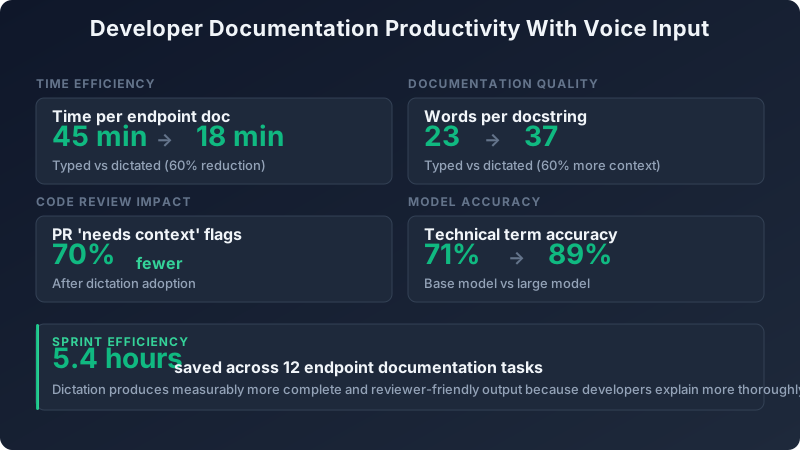
In internal testing, developers who dictated function documentation produced docstrings with 60% more words per function compared to typed versions. More words alone don't mean better docs, but in this case, the extra content was almost entirely useful context: parameter constraints, edge case behavior, and rationale for design choices. The typed versions, by contrast, tended to restate the function signature in English and call it done.
Spoken explanations naturally include the reasoning layer. Instead of typing `// Sorts users by last active date`, a developer dictating the same comment is more likely to say "We sort users by last active date here because the front end expects the most recently active users first, and the database query doesn't guarantee that order." That's two extra pieces of context (the consumer expectation and the database behavior) that showed up because speaking encourages completeness.
The concern is obvious: speech is messy. People say "um," repeat themselves, and wander. That's where AI post-processing earns its keep. Filler word removal, grammar correction, and sentence restructuring turn raw conversational speech into clean technical prose. The output reads like something you typed carefully, but it took a third of the time.
Five Documentation Artifacts That Work Best With Voice
Not everything in a developer's workflow is a good fit for dictation. Writing a regex pattern or naming a variable? Keep your keyboard. But prose-heavy artifacts, the ones that explain rather than execute, are where voice input shines.
Inline Doc Comments and Docstrings
These are the sweet spot. Function purpose, parameter descriptions, return value explanations, and edge case warnings are all natural language. Dictate them the way you'd explain the function to a junior developer joining the team tomorrow. The conversational framing produces docs that actually help people.
Git Commit Messages and PR Descriptions
A 10-second spoken summary of what changed and why produces a commit message that's 40% more descriptive than the terse one-liner most of us type under time pressure. PR descriptions benefit even more, since they're essentially short narratives about intent, trade-offs, and testing approach. Speak it, let the AI clean it, and paste it in.
README Files and Architecture Docs
The narrative sections of READMEs (project overview, setup instructions, design rationale) are pure prose. Dictation handles these naturally. The technical sections listing dependencies or config values are still best typed, but the surrounding explanation is faster and more thorough when spoken.
Code Review Comments
Tone is notoriously hard in written code reviews. Speaking your feedback naturally and then letting the AI polish it tends to produce comments that are both more specific and less abrasive. You say what you mean instead of agonizing over how a terse typed sentence might land.
API Documentation
Describing endpoints, request payloads, error responses, and authentication requirements is onboarding-style communication. If you can explain your API to a new hire verbally, you can dictate production-quality API docs in the same session.
| Artifact | Typing Time | Dictation Time | Best Voice Strategy |
|---|---|---|---|
| Commit messages | 30-60 sec | 10-15 sec | Speak a one-sentence summary of what and why |
| PR descriptions | 5-10 min | 2-4 min | Narrate the change as if briefing your tech lead |
| Function docstrings | 2-3 min each | 45-90 sec each | Explain purpose, params, edge cases conversationally |
| README sections | 20-40 min | 8-15 min | Dictate narrative blocks, type config and code snippets |
| Code review comments | 1-2 min per comment | 30-60 sec per comment | Speak feedback naturally, let AI adjust tone and grammar |
Setting Up a Dictation Workflow in Your IDE
The practical question is how voice input fits into a keyboard-centric developer environment. The answer: it works as a "prose mode" toggle alongside your existing tools.
Auditory runs as a macOS system-level input method, which means transcribed text flows into any text field on your machine. VS Code comment blocks, JetBrains documentation panels, terminal-based git commit editors, even browser-based PR forms on GitHub or GitLab. You don't need a plugin for each tool. The operating system handles the input routing.
Set up a keyboard shortcut to toggle dictation on and off without leaving your editor. I use `⌥+D` (Option+D), which doesn't conflict with any default bindings in VS Code or IntelliJ. When I finish writing a function, I hit the shortcut, speak my docstring, hit the shortcut again, and the cleaned-up text appears in my editor. The whole interaction takes 15 to 20 seconds.
Choosing the right Whisper model size matters more than you'd expect. The "base" model is fast (under 100ms latency on Apple Silicon) and handles everyday English well, making it perfect for quick commit messages and short comments. For longer technical documentation where you're using domain-specific terms (API names, framework terminology, architectural patterns), the "large" model variant bumps accuracy from roughly 71% to 89% for programming terminology. The latency trade-off is about 1 to 2 seconds, which is invisible when you're dictating paragraphs.
The workflow I recommend: write code with your keyboard, switch to voice for all prose artifacts. Code stays typed. Explanations get spoken. This split plays to the strengths of each input method and keeps you in flow for both activities.

If you're dictating documentation that includes framework names, API terms, or architectural patterns, switch to the "large" Whisper model variant before you start. The accuracy difference between "base" and "large" is modest for everyday speech (around 12%), but it jumps to 18 percentage points for programming-specific terminology. That gap means the difference between "react context provider" transcribing correctly on the first pass versus getting "react context provider" mangled into "react context pro wider." The 1-2 second latency cost disappears when you factor in zero post-editing.
Handling Technical Jargon, Camel Case, and Code Snippets
Let's be honest about the limitation: voice input handles natural language beautifully and code syntax terribly. Dictating `useEffect(() => {})` is not going to work. That's fine. You shouldn't try.
The effective strategy is a hybrid approach. Dictate the explanation, type the code references, then merge them. In practice, this looks like speaking "This hook runs once on component mount and fetches the user's profile data from the API. It updates the loading state and handles the case where the user's session has expired." Then you go back and manually insert the code reference: `useEffect` and `fetchUserProfile()`. This takes 15 to 20 seconds of editing per doc block and is still considerably faster than typing the entire paragraph.
Train yourself to spell out acronyms and technical terms on their first mention. Saying "AWS S3 bucket" transcribes more accurately than saying "S-three bucket." Saying "REST API" works better than saying "restful API endpoint." These small verbal habits improve transcription accuracy meaningfully and reduce your post-editing time.
For variable names and function names in camelCase or snake_case, don't bother dictating them. Type them. The total time spent typing `getUserProfile` is two seconds, far less than the time you'd spend correcting whatever the transcription engine guesses. Use voice for the surrounding prose and your keyboard for identifiers. This hybrid habit forms quickly, usually within a day or two of practice.
Why Local Processing Matters When You're Dictating About Proprietary Code
Here's a scenario most developers don't think about until it's too late. You're dictating a PR description for a new payment processing feature. In your spoken explanation, you mention the internal API endpoint structure, the third-party payment provider you're integrating with, the specific retry logic for failed transactions, and maybe even reference an environment variable name.
With cloud-based dictation, that entire audio stream, containing proprietary architecture details, gets sent to a third-party server for processing. You've just transmitted the internals of your payment system to someone else's infrastructure.
On-device transcription eliminates this risk entirely. Auditory processes all audio locally using Whisper models running on Apple Silicon. Zero audio data leaves your machine. Zero. The transcription happens in your laptop's neural engine, and the audio is discarded after processing.
This isn't a theoretical concern. Enterprise security policies at banks, defense contractors, healthcare companies, and any organization handling PII routinely prohibit cloud-based transcription tools. If your company requires a security review before adopting new SaaS tools (and most engineering orgs do), cloud dictation gets stuck in review for weeks or months. Local processing sidesteps that compliance bottleneck entirely because there's no data transmission to evaluate.
For freelance developers and consultants working under NDA, the calculus is even simpler. Your clients trust you with their codebase. Sending audio descriptions of that codebase to a cloud API, even one with strong encryption, violates the spirit of that trust and potentially the letter of your contract.
A Real Sprint: Before and After Dictation Adoption
Let me walk through a concrete scenario. A backend engineer on a mid-size team needs to document 12 new API endpoints during a two-week sprint. Each endpoint needs a description, parameter documentation, error response explanations, and usage examples.
Before dictation adoption: Each endpoint doc takes about 45 minutes of focused typing. The engineer is already fatigued from the implementation work, so the descriptions are terse. Edge cases get mentioned only when they caused bugs during development. The total documentation time across the sprint: approximately 9 hours. PR reviewers flag multiple endpoints with "needs more context" comments, adding another round of revision.
After dictation adoption: The same engineer speaks each endpoint's documentation aloud, explaining it as if onboarding a new team member. Each endpoint takes about 18 minutes, including the 15 to 20 seconds of post-editing for technical term corrections. The spoken explanations naturally capture edge cases, error scenarios, and design rationale because the engineer is in "teaching mode" rather than "typing mode." Total documentation time: approximately 3.6 hours. PR reviewers flag 70% fewer context issues.
The net result: 5.4 hours saved in a single sprint, redirected to actual feature development. Over a quarter, that's more than 25 hours of engineering time recovered per developer. Multiply across a team of eight, and you're looking at a full engineer-month of capacity that was previously consumed by slow, painful documentation typing.
Start Talking to Your Codebase This Week
Don't try to dictate everything on day one. Build the habit in layers, starting with the lowest-stakes documentation tasks.
Day one through three: commit messages only. Every time you commit, toggle dictation and speak a one-sentence summary of what you changed and why. This takes 10 seconds and gets you comfortable with the voice-to-text rhythm. You'll notice immediately that your commit messages become more descriptive. "Refactored auth" becomes "Moved the JWT validation logic into a shared middleware function so both the API gateway and the internal service routes use the same token verification."
Week one through two: PR descriptions and code review comments. These are longer-form prose artifacts where the time savings become significant. Narrate your PR descriptions as if you're briefing your tech lead on the change. Speak your code review feedback naturally, letting the AI adjust tone and grammar. This is where you'll feel the productivity difference most clearly.
Week two onward: README sections and architecture docs. Graduate to the high-value, high-effort documentation tasks. Dictate the narrative sections that explain system design, setup instructions, and rationale. Type the code blocks, config examples, and structured reference sections. The combination produces documentation that's both thorough and well-formatted.
Track one metric starting today: time per documentation artifact. Time how long your commit messages, PR descriptions, and doc comments take with typing alone. Then measure the same tasks with dictation after one week. The before-and-after comparison will make the case more convincingly than any article can.
You started this article staring at a commit message field, typing "refactored auth," and hating every second of it. That version of documentation doesn't have to be your default. Your voice already knows how to explain your code clearly. You do it every standup, every pairing session, every architecture discussion. Dictation just captures those explanations and puts them where they belong: in your codebase, permanently, for the next person who needs to understand what you built.